Spring is the season of dream weddings — golden light, gardens in bloom, ever-changing skies. And yet, it is precisely this capricious beauty that places the bride's complexion before one of its most demanding challenges. I have had the privilege of working alongside many brides at spring ceremonies, and I have learned a truth that is rarely said plainly enough: beautiful bridal makeup in spring is not improvised. It is built, product by product, gesture by gesture, anticipating every climatic variable with precision.
This guide is designed to accompany you from preparing your skin, weeks before your Big Day, through to discreet touch-ups between the drinks reception and the evening dancing. Because you deserve a natural, luminous and long-lasting complexion — even in a May downpour.
Why does spring represent a genuine challenge for the bride's complexion?
Humidity, morning dew and sudden showers: what spring actually does to your makeup
Spring is deceptive. Temperatures rise, the air stays heavy with humidity, and showers arrive without warning — sometimes in the middle of an outdoor photo session. These climatic conditions have very real effects on your makeup.
Heat dilates pores. A foundation applied to insufficiently prepared skin migrates, accumulates in expression lines and creates that dreaded "mask" effect. Ambient humidity dissolves powders within a few hours and accelerates sebum production — particularly across the T-zone. The result: what was fresh and luminous at 10 in the morning becomes shiny and uneven by the afternoon. A few drops of rain are enough to shift an unfixed foundation. These are not hypotheses — they are physical mechanisms I observe in the field every season.
The fundamental distinction: "glowy" complexion vs. shiny complexion — why one enriches and the other betrays
This distinction sits at the heart of my work, and yet it is absent from most beauty guides. Glow is reflected light — the kind created by micro-pearls integrated into serum textures, ultra-fine pearlescent pigments placed with precision on strategic areas. It is not sebum. It is not skin saturated with oil. It is a chosen, controlled radiance, anchored in subtlety.
A shiny complexion, by contrast, is endured. It betrays a foundation that has slipped, an uncontrolled T-zone, insufficient fixing. In photographs, the difference is immediate: glow sculpts and illuminates — it plays with spring's natural light. Shine flattens features and draws the eye for all the wrong reasons. Knowing how to distinguish between the two is the first condition for enhancing beauty in an authentic way.
Oily, combination or sensitive skin: mapping your risk zones before applying anything at all
Every skin type is a map. Before considering any makeup technique, it means identifying your risk zones with honesty. The T-zone — forehead, nose, chin — is the first to shine on combination to oily skin. Reactive cheeks flush with the heat. The temples, so often forgotten, are a frequent foundation migration zone under the effect of perspiration.
This personal mapping determines everything: the choice of primer, the texture of the foundation, the density of the setting. Oily skin calls for a mattifying base on the T-zone and a serum foundation solely on the cheeks. Sensitive skin points towards mineral formulas, free from aggressive silicone. There is no universal recipe — there is an approach adapted to each individual profile.
How to prepare your skin several weeks before the Big Day for a luminous complexion that lasts?
The spring skincare routine for the bride: hydration, radiance and protection week by week
Skin preparation is like a wedding: planned well in advance, with method. Eight weeks from the Big Day, the routine takes hold. Gentle cleansing — sulphate-free foam or oil — becomes a morning and evening ritual. A vitamin C serum, applied each morning under moisturiser, progressively evens the complexion and gives skin that radiance which makeup will then amplify. A light barrier cream — suited to spring's climatic variations, neither too rich nor too fluid — maintains hydration without generating excess shine. And SPF 30 minimum is non-negotiable, even on overcast days: spring exposes skin, often without our realising it.
An eye contour treatment, applied with the ring finger in gentle tapping motions, prevents the "accumulated foundation" effect in fine lines. These are simple, consistent gestures that have enriched my expertise across many weddings: it is regularity that makes the difference, not intensity.
Exfoliation and salon treatments: when to schedule them to avoid any rebound effect?
Exfoliation is a precious ally — provided it is not turned into an enemy. A gentle enzymatic scrub, without microbeads, once a week from eight weeks out, refines skin texture and optimises the absorption of active ingredients. Radiance treatments and hydration boosters at the salon — vitamin C facials, gentle mesotherapy, LED treatments — should be scheduled between six and three weeks before the ceremony. Never later.
In the ten days preceding the ceremony, no aggressive treatments. No intense acid exfoliation, no new treatment never previously tested. Skin must be soothed, stable, at its very best. A rebound effect at five days out — redness, flaking, sebum surge — would be far more difficult to manage than simply well-hydrated, unexfoliated skin.
Nutrition and hydration: the unsuspected allies of a naturally luminous spring complexion
Complexion is also prepared from within. In the weeks leading up to the wedding, limiting refined sugar reduces silent inflammation that dulls the skin. Alcohol dehydrates deeply and dilates blood vessels — two effects that are visible in photographs. Tobacco, for its part, impairs microcirculation and gives skin that grey veil which no foundation can fully conceal.
1.5 litres of water per day — coffee does not count as a substitute — is the non-negotiable foundation of a complexion that responds well to makeup. Dehydrated skin absorbs foundation unevenly, accentuates fine lines and will age your makeup prematurely. Omega-3s — oily fish, walnuts, flaxseeds — support the skin barrier from within. These are details that, taken together, make a visible difference.
Which products and techniques should you adopt for a spring bridal natural-look foundation that holds?
The anti-humidity primer: the base that most advice ignores
Primer is the most underestimated product in the bridal makeup kit. And it is precisely here that the hold of the entire day is decided. For a spring wedding, I consistently recommend so-called "water-lock" formulas — long-lasting primers that create a barrier between skin and ambient humidity, preventing foundation from migrating.
The silicone versus silicone-free distinction deserves attention: silicone-based formulas offer immediate smoothing and optimal grip for normal to combination skin, but can saturate oily skin by the end of the day. Silicone-free alternatives, often based on natural polymers, are better suited to sensitive or acne-prone skin. In every case, application technique is decisive: an ultra-thin layer, tapped in with warmed fingertips, never spread with force. The primer must disappear into the skin, not sit on top of it.
Light foundation and creamy textures: the recipe for a "bare skin" effect with radiance
The spring bride's foundation is not the one that covers the most — it is the one that covers best, where needed, whilst allowing skin to breathe. The micro-pearl serum foundation is my formula of choice for achieving a level of excellence in natural finish: it evens the complexion, adds a subtle luminosity, and wears like a second skin.
Long-lasting cushion foundation — so often overlooked in bridal guides — offers a freshness and a semi-matte finish ideal for days when the heat rises. Light-coverage fluid foundation, reinforced with a targeted concealer on blemishes, remains a reliable choice for combination skin. Application technique makes all the difference: tapping motions — with a lightly dampened sponge or the pads of the fingers — create a breathable, natural finish without build-up in pores. Build in thin layers rather than one heavy application.
Placing light with precision: the art of seasonal highlighting anchored in subtlety
Spring highlighting is not a trend — it is a technique of luminous sculpting. And it sits precisely where it should: on the high cheekbones, the Cupid's bow, the bridge of the nose and the temples. Four zones, no more. A liquid or stick highlighter — never powder in humid conditions, which risks clumping or accumulating — deposited in micro-touches with a finger or a fine-tip brush, creates a glow that converses with spring's natural light.
On the cheeks in humid conditions, restraint is everything. The less you apply, the more elegant the effect. Excess highlighting on the cheeks outdoors gives that overexposed appearance which betrays the artifice rather than erasing it. The principle is simple: light is suggested, never saturated.
Spring blush, brows and lips: the finishing touches that enhance beauty authentically
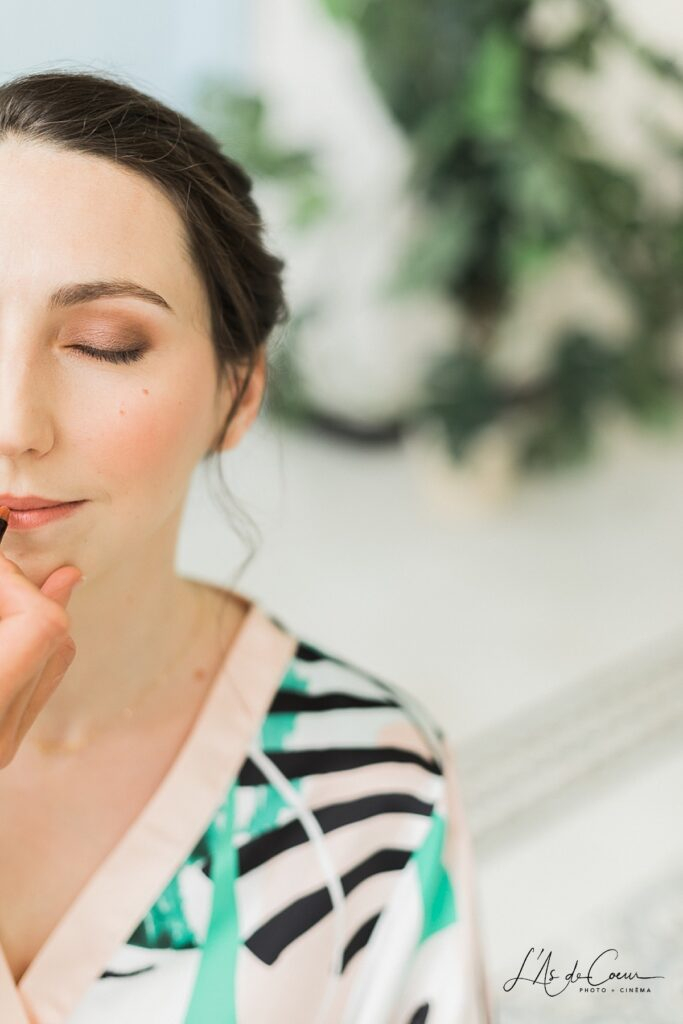
Coral or apricot cream blush — tapped lightly onto the apples of the cheeks — evokes that natural radiance, that flush one has after a walk through the woods in spring. It melts into the skin, adapts to each bride's complexion, and holds far better than powder blush in humid conditions. It is the detail that brings the complexion to life.
Structured yet natural brows — defined with a fine pencil, combed through with clear or lightly tinted setting gel — frame the eyes without rigidity. They should look like your brows, only slightly refined. For the lips, the spring register favours a pearlescent pink gloss for a fresh, luminous effect, or a lightweight long-lasting lip colour for brides who want more intensity without needing to reapply after every conversation. In both cases, a lip liner — even a subtle one — extends wear and refines definition.
How to set and preserve your glowy makeup throughout a spring wedding day?
Setting mist or long-lasting spray: which to choose according to the weather on your Big Day?
Setting is not an optional step — it is the varnish that seals all the work accomplished. And not all mists are equal. For a spring wedding, the families to distinguish are clear: thermal sprays soothe and unify immediately, but their hold remains modest. Matte-finish sprays limit shine throughout the day — perfect for combination to oily skin. Glow-lock formulas set without crushing the light — ideal for normal to dry skin wishing to preserve their radiance. Waterproof formulas, finally, are the insurance policy against showers and tears of joy.
The cross-technique — spray held at approximately 30 cm, in vertical then horizontal movements — avoids localised saturation and ensures even setting. I systematically apply a first layer before powder, and a second layer once the full makeup is complete. This double barrier effect significantly extends wear.
The spring touch-up kit: what a professional makeup artist always slips inside
A good touch-up kit does not weigh heavily — it weighs just right. Blotting papers first: they absorb sebum without disturbing the foundation or erasing the setting. A concealer stick for small blemishes that reappear. A thermal mist to revive the complexion and unify without an additional layer. A compact cream blush to restore colour to the cheeks. A gloss or the long-lasting lip colour chosen that morning. A few cotton buds to correct any mascara smudges.
The touch-up protocol follows the rhythm of the day: between the drinks reception and the dinner, between the dinner and the evening dancing. Two targeted touch-ups, never a full reapplication. The objective is to recover what has evolved — not to start again.
Sudden shower, unexpected heat, tears of joy: anticipating spring's beauty surprises
Even the most carefully prepared makeup can encounter the unexpected. A sudden shower during outdoor photographs. An emotion that overflows at the moment vows are exchanged. A May sun that climbs sharply. These situations are not failures — they are part of the Big Day. What matters is the recovery protocol.
Three gestures, in order: blot gently — without rubbing, never — with a blotting paper or a soft tissue. Apply a setting mist to unify and rehydrate the surface. Reapply with a light touch solely where necessary — concealer, blush, gloss. No complete overhaul. Waterproof mascara is non-negotiable for a spring bride: tears of joy always arrive, and they always arrive when least expected. A shiny complexion can be recovered in three minutes with the right tools. Mascara that has run takes far longer to correct — and is far more visible in photographs.
Spring is the season of contrasts: golden light and changing skies, gentle warmth and fleeting showers. It is precisely what I love about weddings in this season — they demand rigorous preparation in order to liberate, at the right moment, something deeply natural. A complexion that breathes, that illuminates, that holds. The privilege of working with spring brides is to transform every climatic constraint into an asset — and to allow you to be fully present, without thinking once about your makeup.