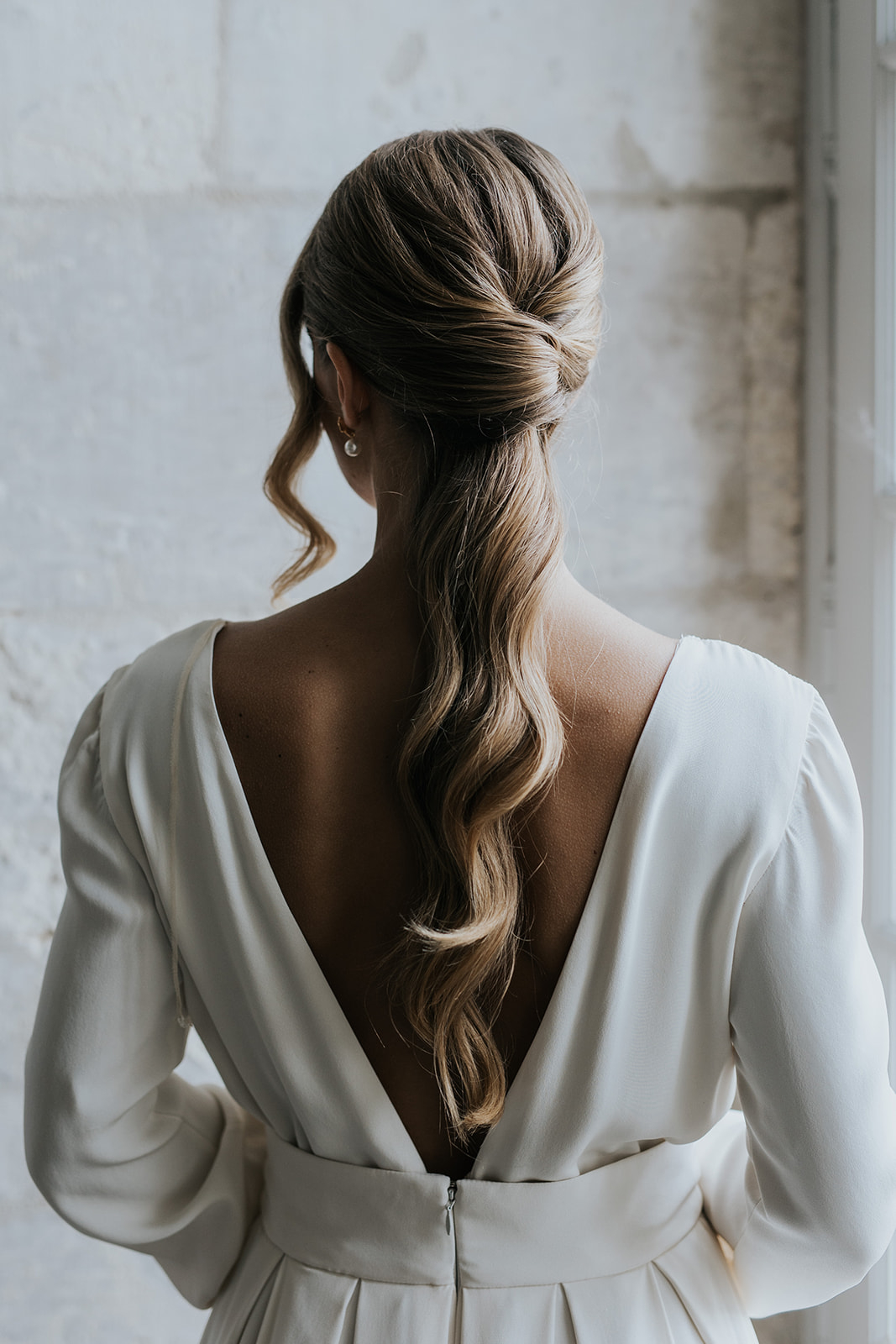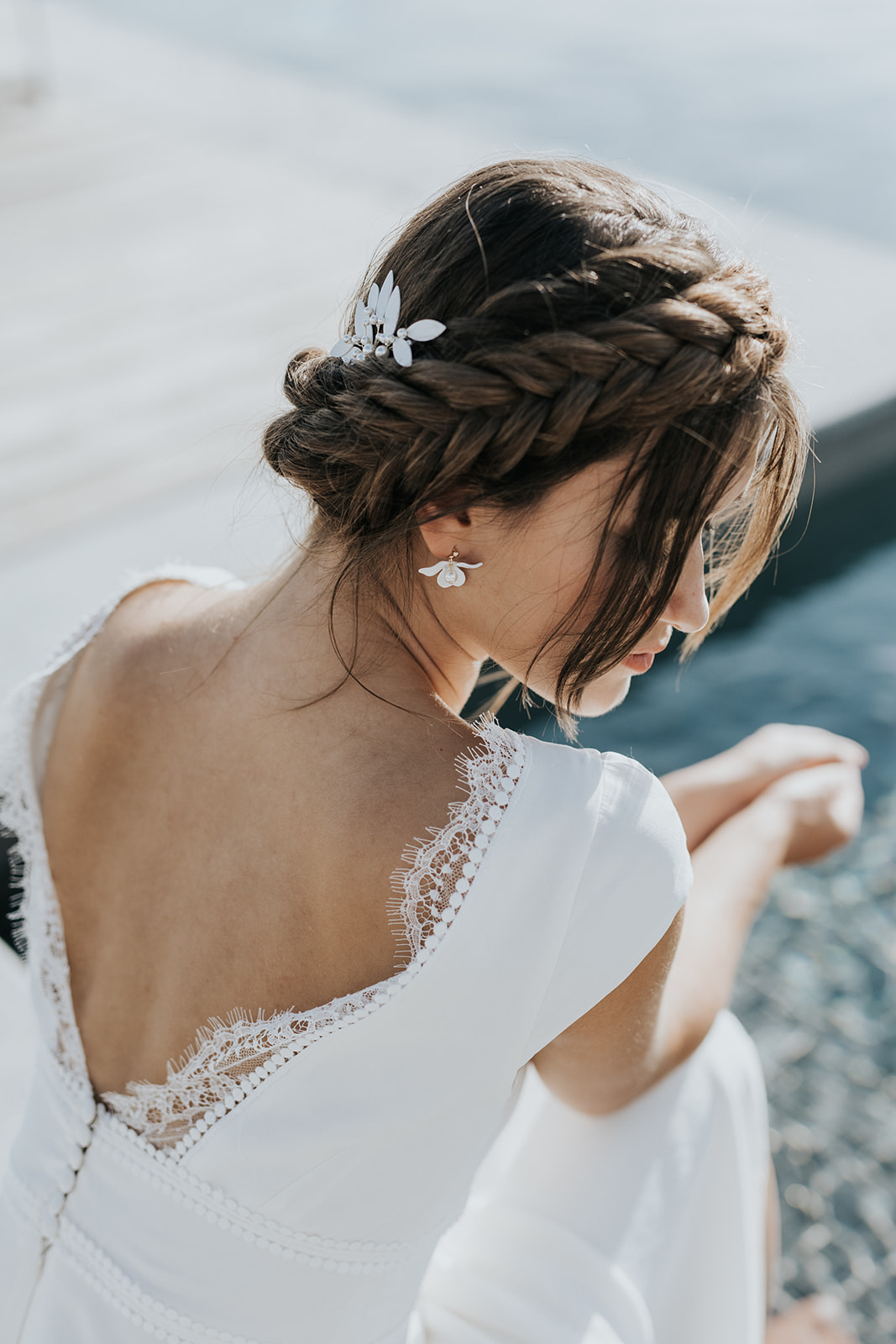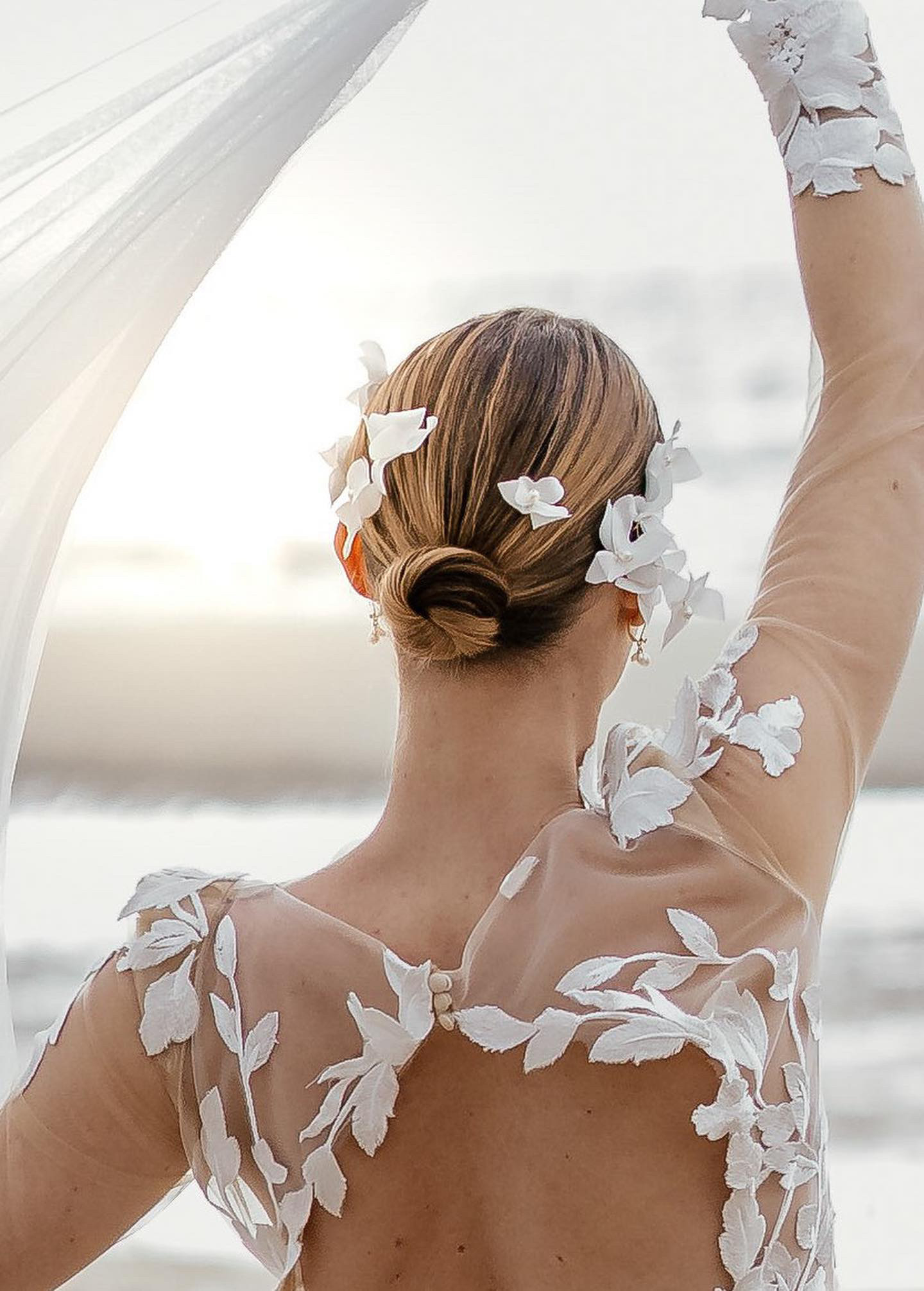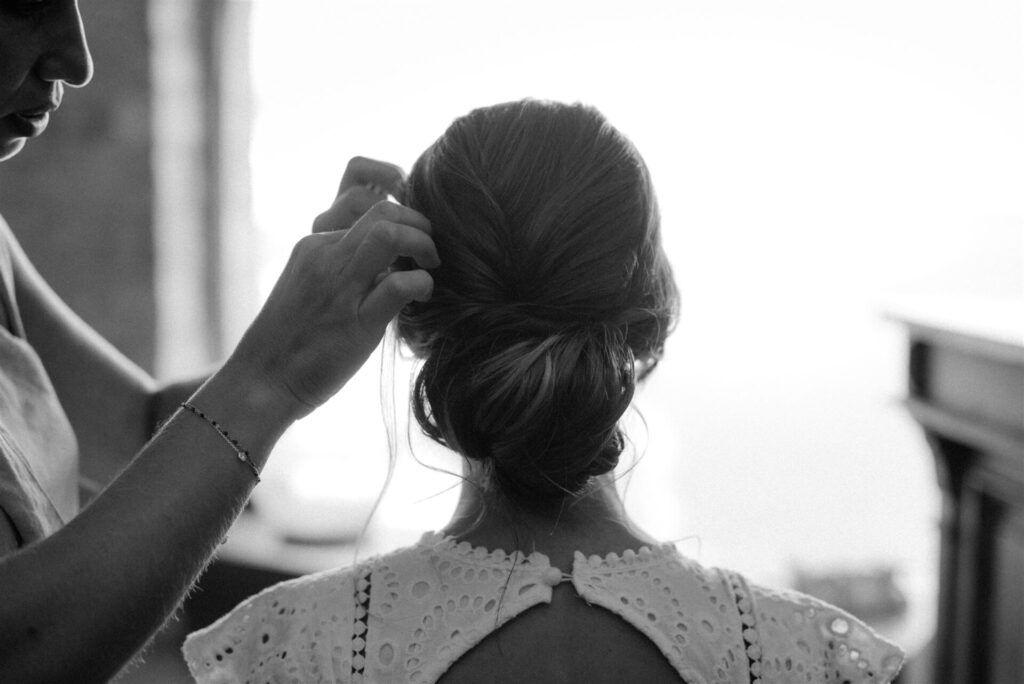
Reducing the execution time of a bridal chignon without compromising its hold requires a rigorous method: preparing the hair in advance, precisely segmenting the work, and mastering two or three techniques adaptable to all hair types. After twenty years working on weddings across Île-de-France, I have identified five concrete levers that allow you to halve this time — even in challenging on-location conditions.
On the wedding day, time is not yours to control. You are working in a sometimes cluttered flat, with unpredictable lighting, an emotional bride, and a schedule that cannot afford a single delay. I have lived through those mornings hundreds of times. And it is precisely that repeated pressure which has enriched my expertise with a dimension that conventional training never teaches: managing technique under real constraints. I built these five methods gradually, refining them season after season, until they reached a level of excellence I can now pass on to other professionals.
Before we dive in — discover the chignon training I offer to professionals.
Why Execution Time Is a Strategic Issue for Wedding Hairstylists
The Wedding Day Paradox: Perceived Quality vs Time Reality
A bride does not see your hours of practice. She sees the result, feels your composure, and perceives — even unconsciously — whether you are in control or improvising. A professional who works quickly and well inspires immediate confidence. One who lingers, even to produce an identical result, creates a tension that colours the entire morning.
Halving your execution time is not about raw speed. It is about method: every minute saved is a minute returned to presence, attentiveness, and the relationship with the bride. That is where the difference between a competent service and a truly memorable one is made.
Technique 1 — Hair Preparation: the First Lever for Acceleration
Texture, Hydration and Grip: the Three Pillars of Rapid Preparation
Everything begins before the first pin is placed. Poorly prepared hair resists, slips, and falls apart. Well-prepared hair is workable: it holds shape, accepts twists, and anchors pins effortlessly.
The rule I apply without exception: neither too clean nor too heavy. Hair washed the day before, lightly textured with a salt spray or a light pomade suited to the hair type, offers the best working foundation. On very straight or very fine hair, I add a light pass of hairspray before even beginning the chignon. That single reflex alone can save five to eight minutes over the course of the styling.
Technique 2 — Zone Segmentation: Working Quickly Without Losing Control
The Three-Zone Rule to Eliminate Improvisation
Improvisation is the enemy of time. When you begin a chignon without a clear plan, you backtrack, undo what will not hold, and lose the thread. Segmenting into three zones — nape, sides, crown — is the framework that eliminates this structural loss of time.
Technique 3 — The Anchor Point: a Stable Base Achieved in Under Ten Minutes
The anchor point is the technique I consider the foundation of every lasting bridal style. Unlike a chignon built surface by surface, the anchor point starts from a central twist pinned deep, directly against the scalp. It does not move. It withstands dancing, wind, emotion, and the passing hours.
Once mastered, its construction takes between eight and twelve minutes. Everything else — sculpted sections, delicate wisps, accessories — is added on top without effort, because the base will not give way. I call this working anchored in subtlety: building something invisible that supports everything that is seen.
Technique 4 — Flat Pins: the Most Underestimated Tool in the Field
Every professional has her preferred pins. But the mistake I see most often amongst hairstylists in advanced training is the systematic use of straight pins where flat pins would be twice as fast and three times as secure.
The flat pin — also known as a bobby pin — is inserted by crossing two layers of hair simultaneously. It requires no repositioning. It does not slip. And it disappears beneath the hair without leaving any visible trace. Replacing 30% of straight pins with well-placed flat pins can reduce finishing time by ten minutes on an elaborate chignon.
Technique 5 — The Express Finish That Creates the Illusion of Time Spent
The finish is the moment where many professionals lose precious time in pursuit of absolute perfection. Yet what the bride and her guests perceive is not the millimetre-precise placement of every strand, but the overall harmony of the style.
I apply a simple rule: after each completed chignon, I take three seconds to step back, correct a single point — the most visible one — and stop. A light mist of hairspray follows, applied from a distance to avoid weighing down the hair or creating shine, simply to set it. This closing reflex, learnt through experience, prevents the endless retouching that improves nothing and consumes everything.
What Practice Alone Cannot Replace
When Structured Training Genuinely Changes Everything
I have had the privilege of working alongside talented hairstylists who had plateaued for months on the same difficulties. Not through lack of effort — but through lack of framework. Repeated practice without external feedback consolidates technique, including the flawed ones. It optimises what you already know how to do, without opening new doors.
A short, intensive, field-focused training course allows you to authentically elevate what self-teaching has built: it does not start from scratch, it restructures. It names what was working intuitively, corrects what was resisting without you knowing why, and opens conscious access to techniques you will in turn be able to pass on.
This is exactly what I offer in my chignon training: a structured space for progression, amongst professionals, with real on-location scenarios and a practitioner's perspective sharpened by twenty years of weddings.
Discover the full programme of my bridal hairstyling training.
In Summary
- Preparing the hair before you begin (texture, grip, light hairspray) saves up to eight minutes during styling.
- Segmenting the head into three zones — nape, sides, crown — eliminates back-and-forth and streamlines execution.
- The anchor point, built deep from the nape upwards, is the most reliable hold foundation for a long wedding day.
- Replacing 30% of straight pins with flat pins noticeably reduces finishing time.
- A strict closing rule — one single correction, one light pass of hairspray, then stop — avoids pointless retouching.
Frequently Asked Questions
How long does it take to create a professional-quality bridal chignon?
A high-hold bridal chignon by an experienced professional takes between 30 and 50 minutes depending on hair length and texture. With a structured method and proper hair preparation, this time can come down to 20–25 minutes without any compromise on durability.
Which chignon technique holds best over a long wedding day?
An anchored chignon — built around a pin point set deep rather than at the surface — offers the best resistance to movement, humidity, and outdoor conditions. It forms the ideal base for all aesthetic variations, from the most minimal to the most ornate.
Do rapid chignon techniques suit all hair types?
Yes, provided the preparation is adapted accordingly: texturising products for straight hair, light blow-drying and fine hairspray for fine hair, reinforced flat pins for thick hair. The technique adjusts; the principle remains the same.
How can I progress quickly in bridal hairstyling when my chignon training is limited?
Practice alone is not enough: without a pedagogical framework, you consolidate existing technique without acquiring new ones. An intensive training course led by a practitioner actively working on weddings allows you to reach thresholds you cannot reach alone.
What does a professional bridal chignon training course cover?
A serious training programme covers anchoring zones, the mastery of several adaptable base techniques, time management under real conditions, and the finishing touches that enhance the final result. It includes practical work on a model and individualised feedback on technique.
A bridal chignon is not simply a hairstyle: it is a promise kept under pressure, a creation that must remain flawless from the ceremony to the last dance. Twenty years have taught me that execution speed is not the opposite of quality — when properly built, it is its most eloquent signature.