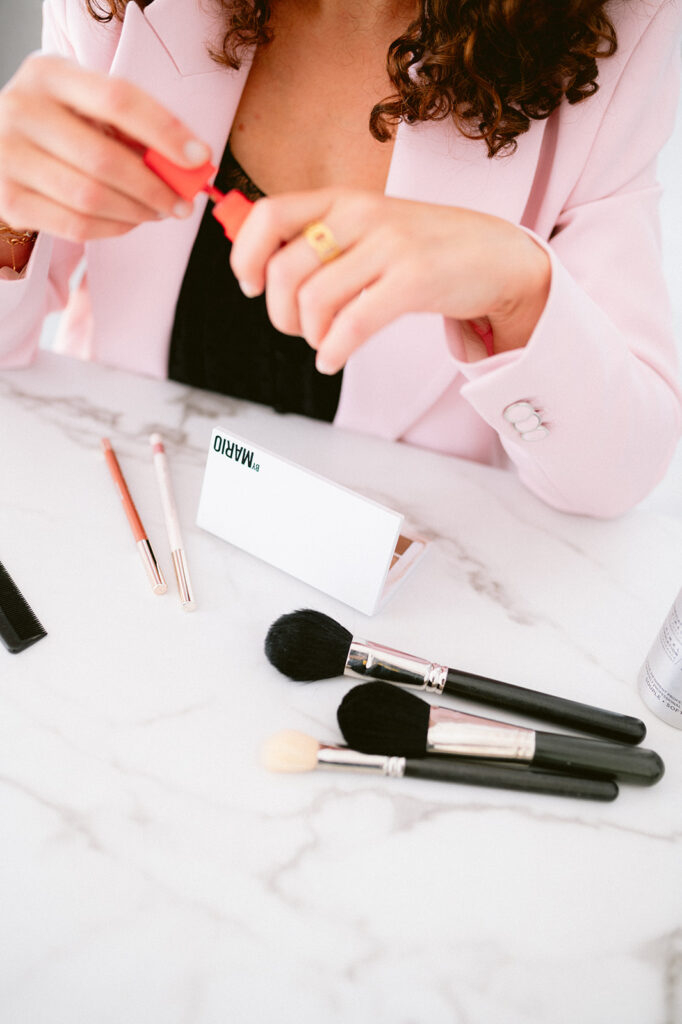
In the banking world, every detail of your presentation contributes to establishing trust with your clients. Your makeup forms an integral part of this professional equation. After accompanying hundreds of finance professionals, I've observed that a polished appearance is never accidental: it results from a refined understanding of the sector's expectations and a perfectly mastered routine.
Why does professional makeup influence trust in banking?
The visual expectations of banking clients
When a client walks through your establishment's doors to discuss their assets or request credit, they assess your credibility within seconds. Your appearance constitutes the first message you send them, well before any verbal exchange. Studies in behavioural psychology demonstrate that the initial impression forms in less than seven seconds and durably influences the perception of your competence.
In the banking sector, this visual expectation translates into a delicate balance: you must inspire trust and professionalism whilst remaining approachable. Your makeup helps create this harmony. A neglected face suggests a lack of rigour, whilst overly heavy makeup can create distance with the client. I've observed this during branch training sessions: advisers who master this balance establish a relationship of trust more rapidly.
The balance between credibility and accessibility
Finance rests on trust. Your role consists of reassuring your clients about the management of their money. Your presentation must therefore simultaneously project two apparently contradictory qualities: professional authority and human proximity.
Discreet yet polished makeup communicates that you attach importance to details. This attention reassures the client about your capacity to meticulously manage their finances. Simultaneously, a natural result preserves the authenticity of your relationship. I always recommend to my banking sector clients to aim for the "I'm naturally like this" effect rather than "I've spent an hour preparing myself".
What banking dress codes reveal about the expected image
Traditional financial establishments often impose strict appearance charters. These codes aren't arbitrary: they reflect the image of stability and seriousness the institution wishes to project. In private banks and high-end establishments, the requirement proves even more exacting.
These dress codes teach us that appearance forms part of the service promise. Appropriate makeup signals your understanding of sectoral expectations and your capacity to comply with them. This conformity reassures clientele about your integration of the company's values.

What are the golden rules of makeup in a banking environment?
The rule of enhanced natural rather than transformed
The fundamental principle of banking makeup holds in three words: enhance, don't transform. Your objective consists of sublimating your natural features whilst remaining recognisable. Your colleagues and clients must perceive you as the best version of yourself, never as a different person.
This philosophy implies working with your natural complexion rather than modifying it radically. Choose foundations that perfectly match your skin colour. Favour light textures that allow your skin texture to show through. The desired effect? Unified skin that simply appears rested and radiant.
The shades and textures authorised in finance
The banking palette comprises primarily neutral and earthy tones. For eyes, opt for beiges, taupes, soft browns and pearl greys. These colours structure the gaze without ever weighing it down. Satin finishes surpass overly shiny metallics or glitter, which are totally forbidden.
For lips, natural pinks, nudes and rosy beiges dominate. Avoid bright reds, fuchsias and any shade that would draw the gaze to your mouth rather than your words. The empirical rule I apply: if you're wondering whether it's too much, it probably is.
Matte or semi-matte textures are essential. Excessive shine, whether from gloss or overly generous highlighter, clashes in the hushed universe of banking establishments. Aim for fresh but never shiny skin, hydrated but never glossy lips.
The absolute prohibitions to know before your first day
Certain mistakes can compromise your professional integration. Heavy smoky eyes, even perfectly executed, remain unsuited to the banking environment. The same applies to graphic eyeliner or spectacular false lashes. Your eye makeup must illuminate your gaze, never transform it into an artistic statement.
Very drawn or visibly redrawn eyebrows also stand out. Favour subtle work that densifies and structures without creating an artificial effect. Overly pink or orange blushes that streak the cheeks belong to another era. Prefer a delicate touch that warms the complexion naturally.
Finally, forget heavily contoured Instagram-style makeup. This technique, spectacular in photographs, appears out of place in natural light. In an office bathed in cold light, heavy contouring will simply make you look like you have visible makeup traces.
Adapting your makeup according to your position: front office vs back office
Your level of public exposure determines your creative latitude. In front office, facing clients, the rules apply strictly. Your makeup must embody the establishment's image. Every detail counts because you represent the bank in the public's eyes.
In back office, you generally benefit from greater flexibility. You can explore slightly more pronounced shades or somewhat more assertive styles, as long as you remain within the professional register. But beware: even in back office, you might be called to a client meeting or encounter partners. It's therefore better to remain within acceptable codes.
Management positions call for exemplary sobriety. The higher you climb in the hierarchy, the more your appearance must reflect authority and restraint. I've noticed that women in management positions often adopt even more pared-down makeup, letting their expertise speak for itself.
How do you create your morning makeup routine as a banking adviser?
Unified complexion: foundation of a professional appearance
Your routine begins with impeccably prepared skin. After your moisturiser, let it penetrate for a few minutes. This step guarantees that your makeup won't slip throughout the day. Then apply a smoothing primer on areas where your pores are visible or where your skin naturally shines.
For foundation, select a long-lasting formula with buildable coverage. Place small dots on your forehead, cheeks, nose and chin, then blend outwards with a brush or damp sponge. Blend meticulously at the jawline to avoid any demarcation. Your neck and face must form a perfect continuum.
Concealer then targets dark circles and small imperfections. Choose a shade slightly lighter than your foundation to illuminate the gaze. Tap gently with your ring finger, the finger that exerts the gentlest pressure. Set everything with translucent powder applied with a brush on the T-zone, without weighing down the cheeks.
Sublimating the gaze without attracting attention
Your eyes deserve particular attention: they establish contact with your interlocutors. Begin by applying an eyeshadow base that will intensify pigments and prolong wear. Then sweep a light neutral shade over the entire mobile eyelid to unify.
In the crease of the eyelid, deposit a darker shade (taupe, soft brown) that you'll blend in circular movements. This light shadow creates depth without ever appearing made-up. Lighten the brow bone and inner corner of the eye with a touch of golden beige or matte champagne.
For lashes, one or two coats of brown or black mascara suffices. Favour formulas that lengthen and separate rather than those that volumise excessively. If your lashes are light, professional tinting can transform your gaze whilst reducing your morning routine.
Your eyebrows frame your face and structure your gaze. Brush them upwards, then fill sparse areas with a fine-tipped pencil or powder. Movements must mimic natural hairs. Set with transparent gel so they remain disciplined all day.
Lips: finding the right intensity
Your lips complete the harmony of your face. First hydrate them with a balm that you'll let penetrate whilst you make up the rest of your face. This base prevents dry lips and facilitates lipstick application.
For a professional result, lightly trace the outline of your lips with a nude pencil matched to your natural colour. This step prevents lipstick from bleeding into fine lines. Then fill in with a creamy or matte lipstick in a nude, natural pink or rosewood shade.
Blot with a tissue, then apply a second coat for longevity. If you prefer an even more discreet effect, deposit the product with your finger and blend it with light tapping. The result? Visibly groomed but subtly coloured lips.
Long-lasting wear: discreet touch-ups during the day
Even the best-applied makeup requires some adjustments. Keep a small touch-up kit in your desk drawer: mattifying powder, your lipstick, blotting papers and a mini-mascara.
Around midday, tap a blotting paper on your T-zone to absorb shine without adding material. If necessary, apply a light touch of powder. Avoid layering too much: this would create a plastered effect. Refresh your mouth after lunch, checking that no food residue remains.
Keep a good-quality mirror to hand. Discreetly check your appearance before important meetings. Mascara that has migrated under the eye or lipstick that has smudged can harm your professional credibility. Better safe than sorry.
What hairstyle accompanies successful banking makeup?
The hairstyles favoured in financial establishments
Your hairstyle extends the message of professionalism initiated by your makeup. In the banking environment, structured and controlled hairstyles dominate. The classic low bun remains a safe bet, particularly for important client appointments. Elegant and timeless, it clears the face and projects authority.
The smooth low ponytail constitutes a modern and streamlined alternative. Place the fastening at the nape rather than the top of the head to preserve sobriety. Wrap a strand around the elastic to conceal it. Loose hair remains acceptable if impeccably styled and disciplined.
The bob at chin or shoulder level appeals to many banking professionals. This structured cut only requires careful blow-drying to embody professionalism. Avoid overly elaborate hairstyles that would draw attention to your hair rather than your expertise.
Long, medium-length or short hair: what changes everything
Your hair length influences the options available to you. Long hair offers great versatility: bun, low plait, ponytail, or loose with impeccable blow-drying. The advantage? You can adapt your hairstyle according to the day's circumstances.
Medium-length hair, stopping at the shoulders, perhaps represents the ideal compromise. Long enough to be tied if needed, short enough for easy maintenance, it suits dynamic days perfectly. A well-cut long bob elegantly frames the face whilst remaining practical.
Short hair projects determination and efficiency. A structured short bob or well-maintained pixie cut communicates self-confidence. Regular maintenance becomes indispensable: a neglected short cut is immediately noticeable. Plan a hairdresser visit every four to six weeks.
The authorised hair accessories and those to avoid
Hair accessories in banking obey the rule of discreet invisibility. Fine hair clips in neutral tones (black, tortoiseshell, discreet rose gold) can hold a rebellious strand without attracting attention. Hairpins must remain hidden, serving only to structure your hairstyle.
The fine, classic headband passes in certain establishments, provided it's sober and of excellent quality. Ban ornate models, bright colours or novelty materials. Elastics must also remain discreet: choose them in your hair colour or opt for models covered in neutral fabric.
Absolutely avoid coloured scrunchies, sports headbands, pin-up style knotted scarves, or any accessory that would divert attention. Shiny hair clips, rhinestone-adorned barrettes or artificial flowers have no place in the banking universe. The golden rule: if the accessory is noticeable, it's unsuitable.
The overall coherence: from makeup to hairstyle through to accessories
Your professional appearance forms a coherent whole. Your makeup, hairstyle and accessories must dialogue harmoniously. If you opt for a very structured bun, your makeup can be slightly more present. Conversely, a voluminous hairstyle will call for more streamlined makeup to maintain balance.
Your jewellery extends this harmony. In banking, minimalism prevails: a pair of discreet earrings, an elegant watch and possibly a fine ring suffice. Imposing jewellery, bracelets that click or rings on every finger disturb the expected image of sobriety.
The colour of your clothes also influences the choice of your makeup shades. An outfit in cool tones (grey, navy blue, white) accommodates fresh pink lips well. Beige or camel outfits harmonise better with nude-peach shades. This attention to detail reveals your sense of refinement.
Your professional appearance in banking is never the result of chance. It results from an in-depth understanding of sectoral codes and technical mastery that refines over time. Makeup adapted to the banking environment allows you to immediately establish your credibility whilst preserving your authenticity. It's this subtle alchemy between compliance with expectations and expression of your personality that makes all the difference in your professional journey.

