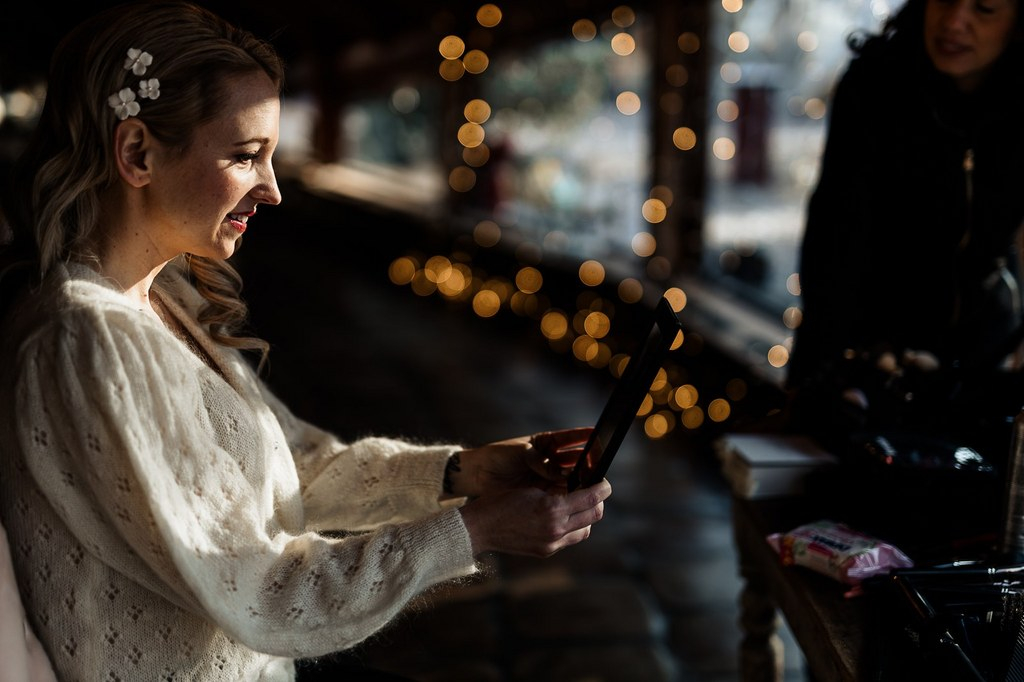
Getting married in winter offers a fairytale atmosphere, almost suspended in time. The low light, the possibility of snow, and the elegance of warm fabrics create an unforgettable setting. I have the privilege of working with many brides-to-be who choose this season to say "I do". While the winter aesthetic appeals with its poetry, it imposes very real technical challenges for your beauty look.
The cold bites, the wind dries, and the thermal shock between the outdoors and heated rooms puts the skin to the test. Achieving successful makeup and hair requires meticulous preparation and specific products. My goal here remains simple: to share with you the protocols I apply to guarantee an impeccable result, from the first look until the end of the evening.
How to prepare your skin before a winter wedding?
Healthy skin constitutes the canvas for any successful makeup. In winter, the hydrolipidic film thins, making the epidermis more vulnerable. Your preparation must begin well before the morning of the wedding to counter dullness and redness.
The intensive hydration routine 15 days before the D-day
Two weeks before the ceremony, your skincare ritual must switch to "close protection" mode. The common error consists of waiting until the day before to act. Yet, the cell renewal cycle requires time.
I recommend doubling your internal water intake. Water remains the primary vector of radiance. On the cosmetic side, integrate a hydrating essence immediately after cleansing. It gorges the skin with water and facilitates the penetration of subsequent active ingredients. In the evening, "slugging" (applying a thin layer of Vaseline or occlusive balm over your night cream) can work miracles on very dry areas, provided your skin tolerates it. This technique seals in hydration and repairs the skin barrier while you sleep.
Serums and nourishing care: which to choose for your skin type
The choice of serum determines your skin's comfort throughout the day. In winter, hyaluronic acid is not always enough, as dry air can sometimes cause the reverse effect by drawing water from the skin outwards.
- Dry and mature skin: Opt for oil-serums or formulas rich in ceramides and squalane. These biomimetic lipids reinforce the intercellular cement.
- Combination to oily skin: The cold does not spare oily skin, which can become dehydrated and overproduce sebum in reaction. Opt for aqueous serums enriched with vitamin B5 (panthenol) which soothe without weighing down.
Application should be done by gentle pressure, palms flat on the face, to help the product penetrate without creasing the tissues.
Scrubs and masks: adapted frequency for a radiant complexion
Exfoliation guarantees that reflection of light we all seek. Beware of grain scrubs, often too aggressive on skin sensitised by the cold. I favour enzymatic exfoliants or those with gentle fruit acids (PHAs), which are much more respectful.
Use them once or twice a week maximum. Follow immediately with a hydrating mask applied in a thick layer. For an immediate "radiance boost" effect, sheet masks impregnated with serum kept in the fridge a few minutes before application decongest features and tighten pores. It is a simple gesture that ideally prepares the ground.
Which hairstyle withstands cold and humidity on the wedding day?
Humidity, wind, and static electricity represent the dreaded trio of winter weddings. Over the years, I have enriched my expertise by observing how hair reacts to the elements to propose durable capillary architectures to you.
Structured buns vs hair down: advantages and limits
The choice of hairstyle must take into account your outfit, notably the presence of stoles, faux fur, or high collars.
Hair worn down, although romantic, carries risks. Constant friction against a coat or scarf creates static electricity and knots at the nape of the neck. If you absolutely insist on wearing your hair down, I direct you towards very soft "Wavy" undulations, fixed with care, which support movement better than dead-straight styling.
The bun remains the safest option. A low bun, slightly unstructured but solidly pinned, will withstand gusts of wind during outdoor photos. It exposes the neckline and avoids any conflict with the voluminous collars of your outerwear.
Fixing products and anti-humidity sprays for long-lasting hold
Fixation must not mean a "cardboard effect". The challenge lies in maintaining suppleness while creating a shield against ambient humidity. I use anti-frizz finishing sprays that act as a light waterproofing agent.
For fine hair that tends to "fly" with the cold, the application of a spray wax or a texturising powder at the roots brings body and grip. This allows pins to hold without slipping. Avoid hairsprays that are too wet which, upon contact with the cold, can freeze the hair in an artificial and brittle manner.
Protective accessories: veils, head jewellery and winter crowns
Winter authorises bold accessories. The veil, if long and heavy, can pull on the hairstyle if there is wind. Plan a removable fixing system that is easy to remove after the ceremony.
Materials like velvet for ribbons, or head jewellery integrating pearls and crystals, capture the winter light beautifully. Crowns of dried or stabilised flowers (cotton, thistle, eucalyptus foliage) resist negative temperatures perfectly, unlike fresh flowers which risk "burning" and blackening from frost in a few minutes.
How to protect your bridal makeup against winter aggression?
Winter makeup does not content itself with colouring; it protects. Your face is the only part of your body directly exposed to the elements. The strategy rests on the intelligent layering of textures.
Bases and primers: creating an effective protective barrier
The base stage prepares the skin to receive the product and acts as a shield. Forget ultra-absorbent mattifying bases which risk caking and marking dry patches.
I turn towards hydrating bases, or even slightly silicone-based ones if the skin texture requires it, to smooth desquamations invisible to the naked eye but which foundation could reveal. An illuminating base (strobing cream) applied to the high points of the face compensates for the lack of natural luminosity on grey days.
Shades and textures adapted to pale and dehydrated skin
In winter, the complexion is often paler. The mistake consists of wanting to warm it up excessively with a foundation that is too dark, creating an unsightly line with the neck. One must accept one's skin tone and sublime it authentically.
Cream textures are your best allies. They fuse with the skin and keep a suppleness that powders do not have.
- Foundation: Choose a fluid, hydrating, and luminous formula.
- Blush: A cream blush in rosewood or peach tones gives a very fresh "just back from a walk in the fresh air" effect.
- Powder: Have a light hand. Powder only the T-zone (forehead, nose, chin) with an ultra-fine loose powder. Leave the cheeks free to preserve this "glowy" and lively aspect.
Chapped lips: express care protocol and long-lasting hydrating lipsticks
Lips suffer particularly from the cold. A chapped mouth will ruin the effect of the most beautiful lipstick.
On the morning of the wedding, carry out a very gentle scrub (sugar and honey will do the trick) then apply a thick layer of repairing balm for the entire duration of the hairstyling and complexion makeup. At the moment of making up the mouth, remove the excess.
For colour, matte lip inks can be uncomfortable in cold weather. I recommend satin lipsticks or hydrating lacquers. If you insist on matte, ensure the formula contains nourishing agents. Berry, burgundy, or deep red shades are magnificent in winter and contrast elegantly with the whiteness of the dress and the landscape.
What gestures to adopt on the D-day to preserve your beauty look?
The day passes at breakneck speed. Between emotion, guests' kisses, and temperature changes, your beauty look lives and evolves. A few simple reflexes guarantee its longevity.
Express touch-up kit: indispensable products to carry
Entrust a small survival kit to one of your witnesses. It must contain:
- Your lipstick: For touch-ups after the cocktail and dinner.
- Blotting papers: More effective and less heavy than adding powder. They absorb excess sebum or perspiration without altering the makeup.
- A compact concealer and a small brush: To camouflage sudden redness on the nose or chin due to the cold.
- A pack of tissues: The eye that waters because of the wind or emotion is a classic. Dab the inner corner of the eye, never rub.
Indoor-outdoor transitions: managing thermal shocks without damage
This is the major challenge. You go out for photos in 2°C, you enter a room heated to 22°C. Blood vessels dilate and contract, provoking diffuse redness (flushing).
My advice: do not enter precipitously towards a direct heat source (fireplace, radiator). Let your body acclimatise for a few moments in the hall or entrance. If your cheekbones or nose redden, do not seek to camouflage immediately. Wait for your skin temperature to drop, drink a little fresh water, then carry out a light touch-up with concealer if necessary.
Setting makeup and hair: professional techniques to hold all day
"Setting spray" is not an option; it is a necessity. It fuses the different layers of makeup (foundation, blush, concealer) for a bare-skin finish, whilst forming a protective film. I apply it in a generous mist at the end of the beauty session, forming an X and a T on the face.
For the hairstyle, a final check of strategic pins before leaving your room assures peace of mind. Your hairdresser will ensure the solidity of the veil's anchor. This work, anchored in subtlety, allows you to reach a level of excellence where you no longer worry about your appearance, but fully enjoy your happiness.

